


Reports | 25 05 2020
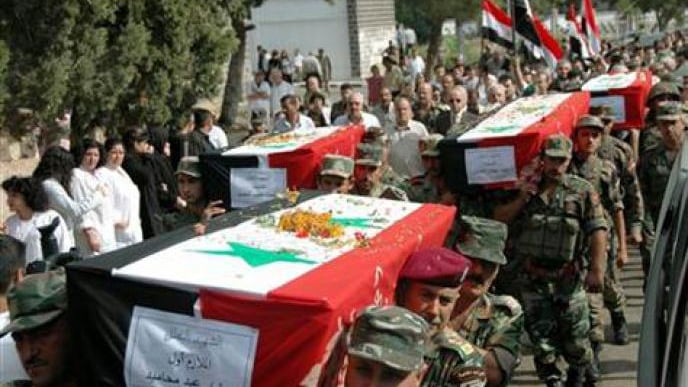
The body of a dead regular army soldier arrives to the village nestled in the Masyaf countryside. Security personnel accompany the funeral, preventing anyone from approaching the body. The family, however, insists on casting a last look at their slain son. After an altercation with security officers they are able to open the coffin, and there was a shocking surprise awaiting them: the face of the victim was completely unknown to them. The funeral’s escorting security patrol, had actually brought the corpse of another soldier. The mistaken corpse of the dead soldier was returned to the Lattakia military hospital, the funeral was canceled, and dead body redirected to where, perhaps, his real family may eventually be able find him.
In another pro-regime village in Tartus, the coffin was opened despite the security escort. The corpse’s face was indistinguishable, having been torn and shredded by a sniper’s shot; yet the family’s real son was taller. After these two stories gained wide circulation, many families started attempting to ascertain if the dead bodies retruned to them were actually those of their own sons. The stern instructions of the escorting security forces prevent them, however, from opening the coffins, even if this means having to bury the bodies without even passing by their family homes.
The Military Hospital: Bedlam
The Syrian security forces responsible for the distribution of the corpses, send out the corpses of dead soldiers to families other than their own. The bodies of many fallen soldiers arrive from the battlefields to the military hospitals or airports, without any IDs or any other documentation proving their identities, on them. In the event a cellular phone is found on the victim, those responsible would resort to contacting one of the names on the phone to attempt to identify the victim; failing which, they would question the victim's comrades with whom they would have served at the barracks. Otherwise, victims are distributed according to a list simply matching the dead, with the neighborhoods and the namelists found in the military barracks.
One of the workers at the military hospital in Lattakia says: "The cold storage room for the dead at the hospital is extremely crowded nowadays; we are even sometimes forced to put two corpses in one unit. It is bedlam all over the place."
He continues by saying that the parents of the deceased, who do not have any connections at the hospital, may end up "searching for days on end sifting through the corpses to locate their deceased loved ones. It will then require them yet another day, or more, to take him out of the hospital." He justifies this chaos by attributing it to "the increased number of deaths. In such situation, it is quite possible that an error may occur, and that a body is dispatched to someone other than the correct family.”
Scouring the Internet
The authorities are, for many reasons, extremely reticent to pronounce the number of their dead, or what happens in the besieged military units. As an example, no one to date has any clear idea of what is happening at the Wadi Daif barracks. If any soldier dies there, their body is summarily interred on the spot, if the military transport helicopter carrying the bodies of the dead faces any kind of delay.
The families of the soldiers thus are increasingly being forced to resort to opposition internet pages, or to videos circulating on social networking sites, which carry details about the ongoing battles and their casualties, to try and know what is happening to their sons.
Post Mortem
The news of one officer’s death reached his family in the Tartous countryside. Syrian security forces informed the family that his body could not be located. The family thus held a funeral without the customary wake, and are hoping in the near future to retrieve the body of their fallen son.
Later, when a soldier detained by the armed opposition factions from al-Tawba prison in the city of Douma in the East Ghouta was released, he told the Syrian security forces who interviewed him, as well as the missing the officer's family, that the officer was alive. They apparently were detained together in al-Tawba prison, and he is currently waiting a trading operation of him and other officers and soldiers detained by the opposition factions.