


Reports | 27 08 2026
 sophia asaad
Sahar al-Yousef says she will enter her village in the Sweida countryside to sit her secondary-school exam, even though she cannot reach the home she left behind after being displaced amid last year’s deadly violence.
Sahar, a member of the 2026 graduating class, says her family fears for her safety on the road to the exam center. The intensive schedule and short preparation period have also made her hesitant. She ultimately decided not to sit the exceptional exams.
Sahar is one of thousands of students who have been given an exceptional opportunity to sit their exams through a special examination session for students in Sweida province, which begins on Aug. 29 and runs for nine days.
Syrian President Ahmed al-Sharaa issued a decree granting students taking the secondary-school and basic-education certificate exams who were unable to sit their 2026 exams an exceptional opportunity to do so.
But the session, which is intended to resolve the crisis of thousands of students being denied the right to sit their exams, is beginning amid local questions and concerns over where the exams will be held, whether the designated centers can accommodate the number of students, and the security and logistical conditions surrounding access to them.
The exams will be held in villages in northern rural Sweida, areas that have been under government control since July 2025 and are now largely empty of the residents who were displaced during the deadly violence that swept the province last year.
The Education Ministry approved an intensive examination schedule for basic- and secondary-school certificate students, spanning just nine days. This has raised concerns among students, who find themselves with very little time to prepare after an interruption that lasted two consecutive years for some of them.
Ten Exam Centers
According to a source at the Sweida Education Directorate who spoke to Rozana, 10 exam centers have so far been designated in five villages: three in Lahitha, three in Khalkhala, two in al-Matouna, one in al-Soura al-Kubra and one in Hazm.
For students living in Sweida city, the distribution of centers means traveling between 28 and 50 kilometers. The distance is even greater for students coming from villages in the southern countryside; some of these villages, for example, are 50 to 90 kilometers from Lahitha.
If students return home the same day, they could travel twice that distance round trip, making securing transportation and arriving on time an essential part of their ability to sit the exam.
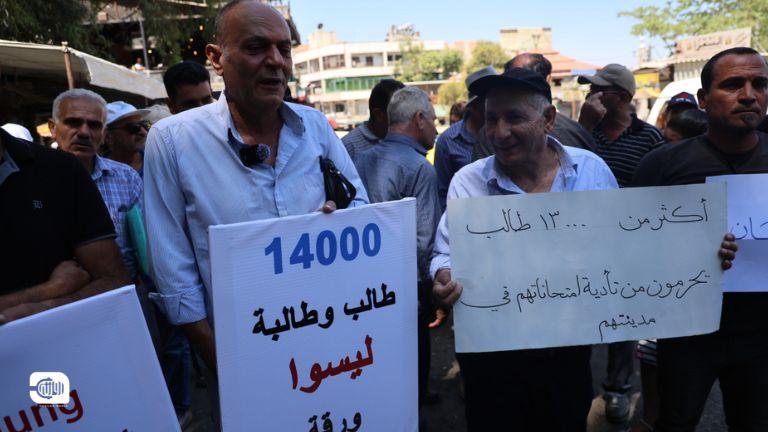
The source added that around 20,000 students are registered for the session, including about 7,500 students taking the 2026 basic-education certificate exam and about 13,000 secondary-school students from the 2025 and 2026 cohorts.
The source said the Education Ministry has assigned around 400 teachers from 34 schools in Sweida province to supervise the exams. Students are expected to find their examination cards waiting for them on their desks when they arrive at the centers, while the Syrian Arab Red Crescent is expected to participate in transporting and accompanying students and supervisors.
But there are still no clear final instructions on transporting students and supervisors. According to the source, the Education Directorate is trying to arrange free and regular transportation for students by coordinating with the Education Ministry and Sweida Governorate.
Teacher Riham al-Halabi, for her part, believes the number of centers designated so far is insufficient to accommodate the large number of students, particularly with around 20,000 names registered for the session.
The Sweida Governorate’s official page has also been reporting daily on preparations since the decree and examination schedule were issued, in cooperation with the Education Ministry, Interior Ministry and Ministry of Disaster and Emergency Management, and in coordination with the Syrian Arab Red Crescent.
In one of its posts, the governorate said the exam centers in the northern countryside were being prepared to receive students, citing maintenance work, the preparation of desks and the provision of basic supplies, with the aim of creating “safe and appropriate” conditions and ensuring the exams run smoothly.
Security Concerns
Teacher Riham al-Halabi told Rozana that a large proportion of students may not attend the exams, citing security concerns as the leading reason.
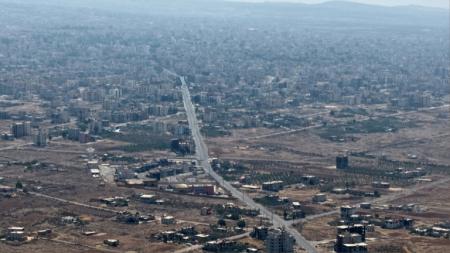
According to her description, reaching the centers in the northern countryside requires passing through National Guard checkpoints, followed by government forces’ checkpoints, and crossing areas along front lines. For many students and their families, the decision to travel to the exam therefore depends first on their assessment of how safe the route is.
Al-Halabi added that the intensive examination schedule has increased students’ frustration, but in her view it is not the main factor behind their decision not to attend compared with security concerns.
She believes holding the exams in the northern countryside does not address the core of the problem and may not be very different from the previous experience of placing exam centers in Jaramana and Ashrafieh Sahnaya in the Damascus countryside, when only a limited number of students attended, accounting for no more than 5 percent.
Between Fear, Despair and a Last Chance
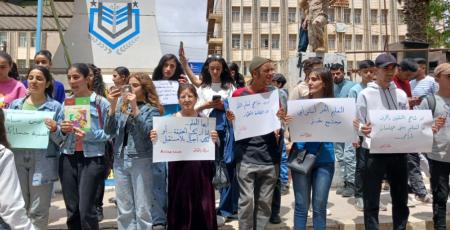
On the ground, students’ positions appear more divided. Last week, calls circulated on social media for a student protest in Sweida against holding the exams in the northern countryside and demanding that they be held inside Sweida city. The call, however, received little response.
Ramzi al-Saleh, a secondary-school student, attributes the low participation to the sense of despair among students after two years of crisis.
Ramzi himself did not sit the secondary-school certificate exams for the second year in a row. He told Rozana that he will also not travel to the exceptional session in the northern countryside because he does not trust the security situation.
Rabi’, a student from the 2025 secondary-school cohort, has chosen to sit the exams. He told Rozana that he no longer trusts that other solutions will emerge, particularly as the university admissions deadline approaches. A student who refuses to sit the exams this time, he believes, may not get another opportunity until next year.
While some students are choosing to go because they see the session as a last chance, others are deciding not to attend because of security concerns or because they cannot prepare within such a short period.
Local Acceptance, but the Decision Is Left to Students
At a press conference held in Sweida last week, Judge Shadi Murshid, chairman of the administrative council formed by Sheikh Hikmat al-Hijri, said the local administration had made every effort to hold the exams inside Sweida city.
But if the northern countryside is approved as the exam location, Murshid said students and their families have the right to decide whether to go, and that the administration should support their decision.
The statements reflect local acceptance of the practical implementation of the exceptional session under the formula approved by the Education Ministry, after holding the exams inside Sweida city had been one of the conditions in negotiations.
An Exam on the Road, Too
Concerns do not end with reaching the exam centers. The Damascus-Sweida highway has experienced repeated tensions and incidents in recent months, at times causing the road to be cut off. The latest occurred last Sunday, raising fears among students and their families that any security incident or sudden escalation could disrupt students’ movement during the examination period.
The issue is particularly sensitive given the intensive schedule. Missing a single exam could mean losing the entire examination session, with no opportunity to make it up, according to some students who spoke to Rozana.
The exceptional session is therefore facing a test that goes beyond students’ ability to answer questions about their school subjects. Its success depends not only on preparing desks and classrooms and assigning supervisors, but also on making it possible and safe for thousands of students to reach their exams.
The exceptional session comes after two years of a crisis that began with the 2025 examinations. Today, as schools in the northern countryside prepare to receive students, the most important question remains:
Will the exceptional session provide a genuine opportunity for some 20,000 students, or will the exam locations and the circumstances surrounding them make reaching the examination room their first obstacle?