


Reports | 20 08 2026
 lody ali
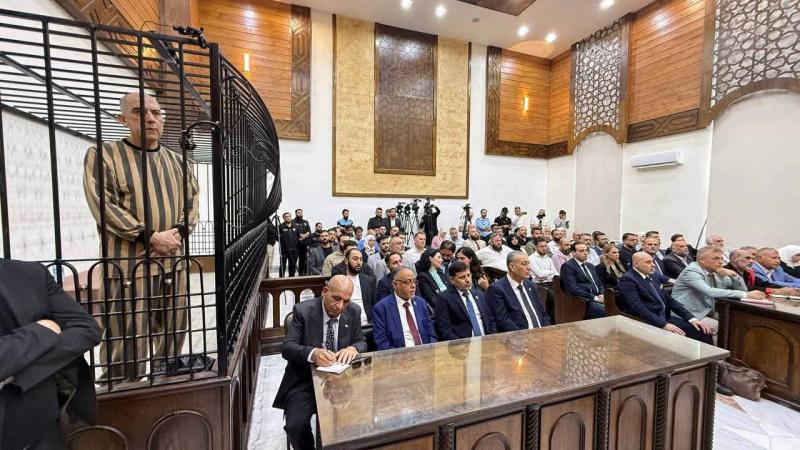
The Fourth Criminal Court specializing in transitional justice on Tuesday, Aug. 11, issued a preliminary death sentence against Atef Najib, the former head of the Political Security branch in Daraa. The court also convicted Bashar al-Assad, Maher al-Assad and several former security and military officials and sentenced them to death.
The ruling is part of judicial proceedings concerning crimes committed during the crackdown on peaceful protests in 2011, particularly in Daraa and events surrounding the Omari Mosque. The ruling remains subject to appeal under legal procedures.
The Trial Proceedings
The sentencing hearing was held after a series of sessions that began in April, during which the court heard arguments from the prosecution, the plaintiff and the defense, as well as witness testimony and evidence presented to the court.
The National Authority for Transitional Justice issued a statement describing the ruling as “an important milestone in Syria’s pursuit of justice, reinforcing the rule of law, ending impunity and securing justice for victims.”
The authority said the ruling “comes as part of a broader and ongoing process that includes uncovering the truth, accountability and prosecution, reparations, preserving memory and ensuring non-recurrence.”
It stressed that the goal of transitional justice is to “reinforce the rule of law, secure justice for victims and build institutions capable of protecting society from the recurrence of such crimes.”
Not the End of the Road
Abdel Basit Abdel Latif, head of the authority, wrote on X: “The truth has made its way to the courts, and today the verdict was issued. In the case of Atef Najib, the court has spoken. This is not the end of the road, but an important milestone on the path toward justice, securing the rights of victims and reinforcing the rule of law.”
Al-Mu'tasim al-Kilani, a specialist in international criminal law, told Rozana that the ruling issued by the Criminal Court is “a preliminary criminal judgment, not yet a final and binding ruling,” noting that it “can be appealed before the Court of Cassation within a maximum period of 30 days.”
“The case is still proceeding before the competent judicial authorities, and an appeal is highly likely in a case involving a sentence of this gravity,” he added.
Kilani said the Court of Cassation has three main options:
Reject the appeal and uphold the ruling, making it judicially final.
Overturn the ruling and refer the case back to the Criminal Court before a different panel.
Partially overturn the ruling, such as by correcting the legal classification of the offense, the sentence or certain procedures.
“If the ruling is overturned, it can no longer be enforced. Instead, the trial is held again within the limits set by the Court of Cassation,” he said.
He noted that “once the Court of Cassation upholds the ruling, the presumed legal process does not mean the sentence is carried out automatically. There is still the stage involving the pardon committee, the approval of the head of state and the executive decree.”
Under Syrian law, the pardon committee, which is formed by a decision of the president, reviews death sentences after they are upheld. It may recommend carrying out the sentence or replacing it with a lesser punishment, while the head of state has the final say on whether the sentence is carried out.
A Public Execution?
Asked about the possibility of a public execution, Kilani said that “the legal rule is that execution is not a public event open to everyone,” citing Article 454 of the Penal Code, which stipulates that hanging takes place “inside the prison building, or at another location designated by the execution decree.”
Article 455 expressly limits those permitted to attend an execution inside a prison to specified officials “and no one else,” thereby barring the public and the media from attending. The phrase “another location designated by the decree” does not automatically mean that a public execution is permitted. Rather, it allows the location of the execution to be changed, but must be read alongside:
The restriction in Article 455 on those allowed to attend when the execution takes place inside a prison.
The prohibition in Article 458 on publishing details of the execution, except for the official record.
Guarantees of human dignity and the principle that punishment should not be turned into a spectacle.
“There is nothing in the current text that gives the authorities the right to broadcast an execution live or open it to the public,” Kilani said. “If an exceptional public execution outside a prison were to be carried out, it would face serious legal and human rights objections. A media announcement alone would not be sufficient; at minimum, it would require an explicit legal basis in the execution decree, and it could still conflict with international standards.”
He added that the law prohibits executions on Fridays and Sundays, as well as national and religious holidays.
Will the Body Be Handed Over to the Convict’s Family?
As for what happens to the body after execution, Kilani explained that “the legal rule cited in Syrian legal scholarship is that the authorities bury the body at their own expense, unless they decide to hand it over to the convict’s family. In either case, the burial must take place without a ceremony.”
Accordingly, “the family does not have an absolute right to receive the body, nor are the authorities always required to conceal the burial site. The decision rests with the competent authority, taking into account the circumstances of the case.”
He added: “Describing a person as a ‘war criminal’ does not, by itself, create a special legal rule allowing authorities to conceal the body or bury it secretly.”
From a human rights perspective, authorities should:
Officially document the death.
Allow the family to learn the fate of the body and the location of the burial.
Refrain from using the body as a means of punishing the family.
Preserve the possibility of an investigation or autopsy if there is a dispute over the manner of death.
Kilani concluded that “what is legally possible is either handing the body over to the family subject to burial conditions, or having the authorities carry out the burial. Permanently concealing the body and the location of the grave is not an automatic consequence of the sentence. It requires specific security and legal justifications, rather than simply describing the convict as a war criminal.”
No Fixed Time Limit
Justice Minister Mazhar Louis, for his part, said the Court of Cassation is not bound by a specific time limit for issuing its decision in the case, in accordance with legal rules and procedures. He explained that a death sentence cannot be carried out until all stages of appeal, review and ratification required by law have been completed.
Louis said the court relied on classifications drawn from international humanitarian law, which, according to him, are consistent with the requirements of securing justice for victims, strengthening justice and preventing impunity.

A Long Judicial Process
The sentencing hearing followed several sessions held by the court since April to try Atef Najib, the former head of the Political Security branch in Daraa, who is considered the first senior security official to be publicly tried in Syria.
The charges against him include killing, torture and arbitrary detention, as well as responsibility for the suppression of peaceful protests in Daraa and the 2011 Omari Mosque massacre.
The ruling remains at an early stage, with the possibility of an appeal before the Court of Cassation and complex executive procedures required before any actual execution can take place, leaving the case open to a lengthy judicial process.