


Reports | 4 06 2026
 Habib Shhada
Farmer Taan has lost his entire wheat harvest this season. His 11-dunum plot in the town of Huwaija Sakr, in Deir ez-Zor province, was more than just land—it was his livelihood and, as he describes it, “the pulse of his life.” He sowed it with wheat and watched the stalks turn green and rise, hoping for a harvest that would help him repay his debts.
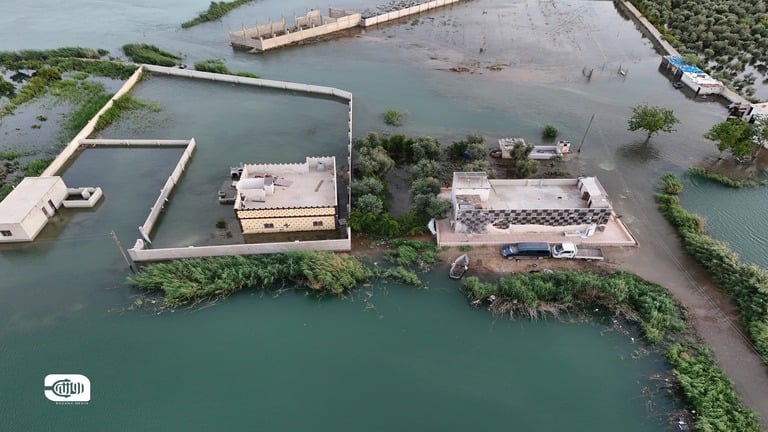
But the Euphrates waters, he says, “swallowed everything in an instant,” after widespread flooding swept through the region. In a single night, floodwaters submerged his land completely and encircled his home until its walls cracked, rendering it uninhabitable. He was forced to flee with his family, carrying only what they could.
Taan’s story is not an exception, but rather a window into the reality facing thousands of farmers and residents in Deir ez-Zor and Raqqa, where floods have caused extensive damage. Estimates suggest that more than 10,000 dunums of agricultural land have been affected in Deir ez-Zor alone.
What happened?
In late May, widespread flooding swept along the banks of the Euphrates River in the provinces of Raqqa and Deir ez-Zor, driven by water releases from Turkish dams exceeding 2,000 cubic meters per second. The surge inundated villages and vast agricultural areas, displacing families from low-lying zones.
The river level rose after reservoirs in Turkey—particularly the Atatürk Dam—filled due to snowmelt and heavy rainfall, prompting Turkish authorities to open spillways at high discharge rates, according to the Director General of the Euphrates Dam Institution, Haitham Bakour.
On May 31, the head of the emergency response committee in Deir ez-Zor province, Fayez Abbas, said—citing the state news agency SANA—that the province had passed the most dangerous phase of the rising river levels and was moving toward full stabilization within 48 hours.
On June 1, the Syrian transitional government announced that the peak danger had been surpassed as water levels began to recede, while the Minister of Energy noted that flooding was gradually easing despite continued inflows from the Turkish side.
The Euphrates Dam—also known as the Tabqa Dam—is located on the Euphrates River about 50 kilometers west of Raqqa. It stretches 4.5 kilometers in length, with a width of 20 meters at the crest and 60 meters at its base.
How severe is the damage?
Powerful water currents in eastern rural Deir ez-Zor caused sections of the earthen bridge in the city of al-Asharah to collapse and go out of service, cutting off transport links between both sides of the Euphrates. Traffic was also disrupted on several key bridges, including the al-Mari’iya bridge, the al-Asharah bridge, and another earthen crossing in Deir ez-Zor, isolating entire villages.
The damage extended to the water sector as well, with more than 50 pumping stations in rural Deir ez-Zor and Raqqa going out of service after their engine rooms were flooded and electricity was cut. Among them were the second al-Baghuz station, Tawi, and Zor Shammar, raising fears of a major water crisis affecting thousands of civilians.
In agriculture, around 24,000 hectares of farmland in Deir ez-Zor and an additional 5,000 dunums in Raqqa were submerged. Strategic crops such as wheat and barley were swept away just as the harvest season approached.
Approximately 2,500 families were directly affected, many of whom were displaced to shelters or nearby villages. No direct fatalities were recorded as a result of the flooding, except for four children who drowned due to strong currents while swimming.
The inundation also affected 265 government facilities and around 60 civilian establishments, in addition to homes in residential and low-lying areas, including the al-Tayyar neighborhood in Raqqa and the al-Huwaij area.
Shortcomings in response
Emergency teams, civil defense units, and local authorities raised their readiness as the Euphrates rose, implementing precautionary measures that included reinforcing earthen embankments, monitoring threatened areas, and carrying out evacuations when necessary, in an effort to protect residents and property and reduce losses.
These measures followed warnings issued to residents living along the riverbanks in Raqqa and Deir ez-Zor after reservoir levels exceeded 97 percent of capacity, raising fears of widespread flooding.
Despite these efforts, the official response faced local and rights-based criticism, which described it as “ad hoc and weak in effectiveness” given the scale of the threat, particularly in agricultural and low-lying areas that were inundated.
Engineers and water experts also criticized structural changes to the water resources sector in recent years, particularly the merger of the ministry with other bodies, arguing that it weakened the technical institutions’ ability to manage water disasters and protect the river from encroachments. This is compounded by the limited capacity of official institutions to respond to flooding impacts after the loss of many technical staff during years of war, without adequate replacement.
UN water expert in Syria, Dr. Ma’an Daoud, said the flooding resulted from “relatively expected high discharge levels,” noting that the Syrian government had been aware of the opening of spillway gates at the Atatürk Dam due to “data exchange and notification” between the two sides.
In a press statement, Daoud attributed the water release from the Turkish side to unusually high rainfall and snowmelt in 2026, in the context of global climate change. He added that what occurred was flooding of land that originally lies within the river’s natural course, but had been used during years of drought due to encroachment on the river’s channel.
For Taan, however, the disaster is not only about losing 11 dunums of wheat. It also exposes the fragility of small farmers in the absence of effective early warning systems and weak regional water coordination. As he puts it, they “have suffered and now live on aid.”
As floodwaters gradually recede, questions of compensation and accountability remain unresolved: who will compensate Taan and others like him for homes that cracked or were swept away, and for fields submerged before their wheat ever reached harvest season?