


Reports | 20 05 2026
 manar abo hason
He did not close his notebooks because he hated school, nor because he failed his exams, nor because a teacher mistreated him. He closed them because the state shut every door in his face and sealed off every horizon before him.
A high-achieving ninth-grade student, not yet 15 years old, had spent months revisiting the curriculum from the beginning. He woke up early each morning, attended private tutoring sessions paid for by his family out of what little they had to survive — 600,000 Syrian pounds a month in a country where salaries barely cover the basics. He studied, memorized and dreamed. Then a single decision issued from an office in Damascus turned all that effort into nothing. He stopped studying immediately and began thinking about work instead. He said nothing to his mother, Amal, but his eyes said everything.
Amal is an administrative educator, someone who understands the meaning of education better than most. She devoted much of her life to following her children’s academic progress and always believed that “true capital is education.” Today, however, she sits between two sons: the elder earned a secondary-school diploma after completing all his exams, yet the certificate remains unrecognized to this day; the younger closed his notebooks and began contemplating work before reaching the age of 15. Between the two, Amal struggles to find words to reassure her children, but the words fail her as well.
This scene is no longer exceptional in Sweida. It has become the daily face of a province enduring one of the most severe educational crises in its modern history. Roughly 13,500 students now stand at the edge of genuine uncertainty. They do not know whether they will sit for exams, where those exams will take place, or whether their certificates will even be recognized once they finish. An entire generation’s future has been turned into a bargaining chip in a political game in which they have no stake.
On May 14, Syria’s Ministry of Education issued Decision No. 1419, stating that, “in light of prevailing conditions in Sweida and in accordance with the requirements of the public interest,” exams for both the basic education certificate and all branches of the general secondary certificate for the 2025–2026 academic year would be held for Sweida students in the provinces of Damascus and Rural Damascus.
Students across Syria are less than a month away from the start of the basic education exams on June 4, followed two days later by the general secondary exams, according to the ministry’s official schedule.
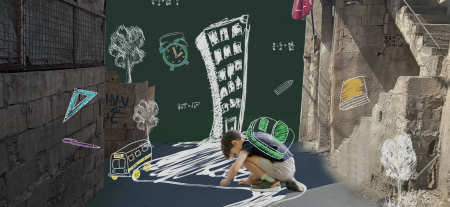
“Disrupting Education”
In response, Sweida’s Directorate of Education said in a statement that depriving students of taking exams in their own “safe examination centers” constituted “a blatant violation of the Universal Declaration of Human Rights and the Convention on the Rights of the Child.” The directorate called for a fair examination environment free from what it described as “educational exclusion and displacement.”
In a statement posted on its Facebook page, the directorate said it had exerted every possible effort to remove obstacles to holding official examinations, stressing that students’ interests stood “above all political or administrative considerations.”
It added that it had shown “complete flexibility” in accepting all conditions imposed by the Ministry of Education in Damascus, including full ministerial supervision and the entry of delegates and exam couriers. Yet, according to the statement, it was ultimately surprised by a decision from “the General Secretariat of the Presidency” rejecting the holding of exams inside Sweida, describing the move as a “deliberate and systematic disruption” of education.
The First Spark: When the Exams Stopped
To understand how matters reached this point, one must return to the pivotal moment in July 2025. The situation later evolved into calls for separation from the state and the establishment of the so-called “Bashan State.”
At the time, twelfth-grade students in Sweida had already completed their first secondary-school examination and were preparing for the remaining subjects when armed clashes erupted suddenly and unexpectedly across the province. That same day, the exams stopped — even as they continued normally and uninterrupted across the rest of Syria.
The students did not know then that this abrupt suspension would become the beginning of a long chain of shocks.
The outcome was decisive and brutal: all of those students were failed. Not because of negligence or poor performance, but because the fighting erupted before they could complete their exams. Thousands of students paid the price for clashes they neither chose nor had any power to avoid.
Following exhausting efforts by the province’s Directorate of Education, an extraordinary examination session was eventually announced, and students believed it might restore what had been taken from them.
In November 2025, students headed to examination centers. Along the way, they passed burned homes, roads torn apart by shelling and neighborhoods whose stones still bore the scars of violence. They knew the road was not fully safe, but they went anyway.
Aya, 18, was one of them. An ambitious young woman who dreamed of studying interior design engineering, she had been studying enthusiastically since mid-2024 despite the events around her narrowing every horizon. When she sat for the extraordinary session, she already knew her concentration was fractured, because what she had seen on the road to the examination center could not simply be erased through focus.
“We passed through areas that were not 100 percent safe,” she said. “We saw destroyed homes and roads damaged by shelling.” Then she added quietly, in the tone of someone describing something that still hurts: “My psychological state reduced my concentration to less than 50 percent.”
Still, they persevered and passed. They celebrated. They dreamed again of university and debated which fields of study to choose.
Only two weeks after the results were announced, however, the Ministry of Education in Damascus delivered its verdict: the certificates would not be recognized, on the grounds that the ministry had not supervised the examination process.
That was the catastrophe.
Students had crossed through conflict zones to sit for their exams, completed them under severe psychological strain, and then received a single response: your certificate is invalid because the ministry did not supervise the exams.
Today, Aya smiles gently while concealing unmistakable grief behind her expression. “I no longer have much hope of entering university,” she said. “My only demand now is recognition of my certificate.”
An 18-year-old woman now asks for only one thing: that the state acknowledge she sat for her exams. She no longer asks for university, no longer asks for the field she once loved. She asks only for recognition. That is what remains of the ambitions of a Syrian girl in the prime of her youth.
Her mother, a retired teacher who spent her life in education and understands its value intimately, does not hide her bitterness. She says her daughter was “bright, ambitious and studied with all her energy,” and that the family, though “working class,” endured major sacrifices to secure her future.
“The refusal to recognize the certificate erased years of effort and my daughter’s hopes,” she said. After a brief silence, she added: “My daughter’s abilities are far greater than the results she achieved, but today I am satisfied with them. I only hope she can enter the field she loves.”
When the Directorate of Education Is Stormed
Amid all this pain and uncertainty — before the province had even absorbed what had happened to its students — Syria’s Ministry of Education issued a decision dismissing Sweida Directorate of Education head Leila Jahjah and appointing a new director in her place.
For many, the move was not seen as a routine administrative reshuffle. Coming at such a sensitive moment, in the middle of an escalating educational crisis, it ignited reactions the ministry may not have anticipated.
An armed group stormed the Directorate of Education building in Sweida city, forcibly removed employees and halted work there.
A place meant to serve as a fortress of learning and refuge for teachers and students transformed, in a single moment, into a battleground for disputes unrelated to education itself. In response, the directorate and several schools launched a protest strike under one clear slogan: respect for education and the dignity of teachers.
The strike ended only after Jahjah submitted her resignation and the Internal Security Service arrested one of the attack’s perpetrators.
The entire episode distilled the deeper crisis: when an education directorate is stormed at gunpoint, when a director is forced to resign under pressure of force, and when teachers strike not for higher wages but in defense of their dignity, it means the educational system itself has become a theater of conflict rather than a refuge from it. And in that theater, students sit in the front rows absorbing blow after blow with no power to defend themselves.
One Hundred Kilometers to Sit an Exam
Amal describes the ministry’s latest decision as catastrophic.
Her family, which had already been paying 600,000 Syrian pounds each month for private tutoring despite worsening living conditions, must now shoulder additional costs for transportation and accommodation in Damascus during the examination period.
That is, if they can afford it at all.
“Renting a place near the examination centers is simply not an option for many families because of the high costs,” she said. Then she pointed to another dimension invisible to decision-makers sitting in offices: “The student will arrive exhausted, on top of the fear and stress of the exam itself and fear of the road.”
She continued: “One hundred kilometers on roads that still carry the memory of clashes, followed by a decisive exam at the end of the journey. That is what the ministry is asking of Sweida’s students.”
Arabic-language teacher Imad Al-Sahnawi said the decision cannot be separated from the framework of international law that Syria itself has signed onto. Article 26 of the Universal Declaration of Human Rights guarantees every person the right to education, he noted.
The International Covenant on Economic, Social and Cultural Rights obliges states to facilitate that right rather than obstruct it. The United Nations Convention on the Rights of the Child — ratified by Syria — likewise affirms the need to guarantee this right to all children and youth without barriers.
Al-Sahnawi spoke in unambiguous terms: “Forcing students to travel more than one hundred kilometers under unsafe conditions constitutes a coercive and systematic deprivation of the right to education, for which the state that signed these treaties bears legal responsibility.”
He also pointed to a stark class dimension that cannot be ignored: this decision does not burden everyone equally. Wealthier families may perhaps be able to afford travel and temporary accommodation in Damascus during the exams.
But for poor and low-income families — the overwhelming majority amid the deteriorating economic conditions in the province — the answer is simple, painful and direct: your children will not sit for the exams. Their right to education is conditional on the size of your wallet.
One Dream, Shattered Twice
In the city of Shahba, Sally, 20, sits with her twin sister facing a future far more uncertain than should confront two young women at the beginning of adulthood.
Their story captures everything.
They sat for the extraordinary session in 2025 under difficult security conditions and passed, only to have the decision not to recognize the certificates destroy everything they had built toward. They decided to continue and retake the exams this year despite wounds that had not healed, resuming preparation even though their motivation was no longer the same.
But the latest decision to move the exams to Damascus left the family facing an impossible equation. The family deeply values education and is committed to their daughters’ future, yet categorically refuses to send the two girls alone to Damascus.
Sally expressed the dilemma in a few heavy words: “Especially because they are girls.”
For anyone familiar with the Syrian reality — and what a long journey through unsafe roads means for two young women traveling alone — the sentence says everything.
Sally added that she no longer trusts any promises regarding future recognition of certificates. The events of 2025 had already delivered a lesson harsh enough.
“With the recent decisions, we lost hope in retaking the exams,” she said.
She once dreamed of studying law, a field she associated with justice, rights and fairness. Now, her dream has shrunk entirely into one thing only: “obtaining a recognized certificate.” No university. No specialization. No ambition. Just recognition. Just proof that the state still exists.
Sally is far from alone.
Samar, 54, spoke of her son, a baccalaureate student who “lost his passion for studying this year after the non-recognition of the 2025 certificate.”
“He did not even register for this year,” she said. “He decided to postpone until next year — if next year proves better than the years before it.”
Then, quietly, she added: “We do not live merely to eat. There must be a goal and an ambition we strive toward in the future.”
But when the state confiscates that goal, what remains for a person to live for?
A “Collective Punishment” Wrapped in Administrative Language
The people of Sweida did not remain silent.
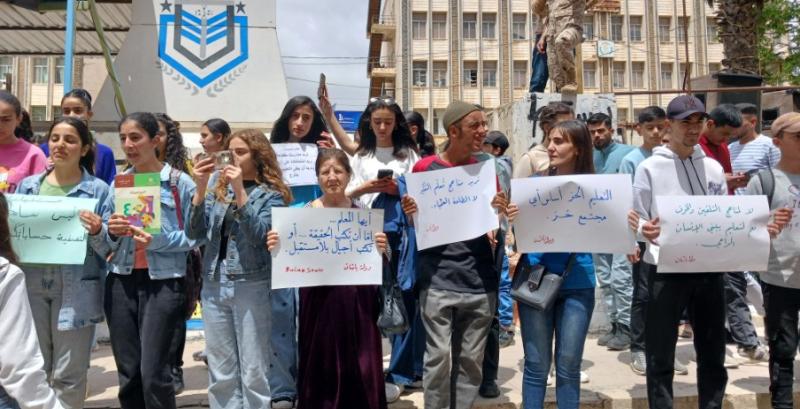
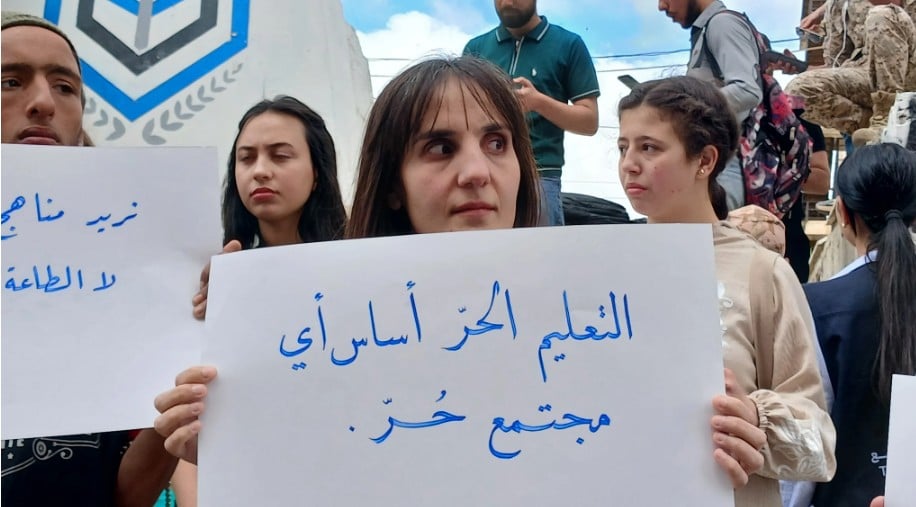
Protests erupted in Sweida city, Shahba and Al-Qurayya, carrying clear and unmistakable demands: hold the exams inside the province under local or independent international supervision; immediately recognize the extraordinary-session certificates of 2025 students; and separate education entirely from political disputes.
Three demands, all converging on one meaning: return our children’s right to a future.
Civil activist and teacher Adonis Ghazaleh said: “Students and families in Sweida are demanding the most basic human and civic right — the right to safe and equitable education.”
She then described the decision in terms she considered fitting: “The decision to move the examination centers is, at the very least, a form of collective punishment wrapped in administrative language.”
“We categorically reject turning the educational process and students’ futures into a political pressure card or a tool for settling scores,” she added. “Using education as a means of punishment constitutes a grave violation against an entire generation and contradicts the principle of educational neutrality as a sacred human right above all political disputes.”
Amal, who now carries the burden of worrying over two sons at once and who understands from her position as a teacher what it means for a child to abandon education at this age, shares that view.
“We fight with education,” she said, her voice balancing firmness and pain. “It is our only weapon and our only ammunition, and our children are our only hope for the future.”
Then she warned of something many may not wish to hear, but which is already happening: if this situation continues, many students will leave school permanently, and the entire course of their lives will change. It is not a threat, she said, but a description of what is already unfolding in many homes.
A Generation at the Crossroads
Thirteen thousand five hundred students.
They are not figures in an administrative report.
They are Aya, who crossed bombardment zones to sit for her exams and now asks only for recognition.
They are Sally and her twin sister, who once dreamed of law and justice and are now trapped by a decision in which they had no voice.
They are Samar’s son, who never submitted his registration papers and now spends his days drifting without purpose.
And they are that high-achieving ninth-grade student who closed his notebooks and began thinking about work before turning 15.
International organizations that signed treaties protecting children’s rights and the right to education are now being called upon to speak clearly — not merely issue statements destined for drawers. And the international community, which frequently invokes education as a fundamental human right, is being urged to translate those words into real and tangible pressure on those who hold decision-making power.
Because an entire generation cannot wait for political calculations to end and for papers to align on negotiating tables.
Closed notebooks do not wait forever.
And when these students grow older without certificates, without universities and without dreams, no one will ask about the decision once issued from an office in Damascus.
But Sweida will remember.
And these students will not forget.