


Reports | 5 05 2026
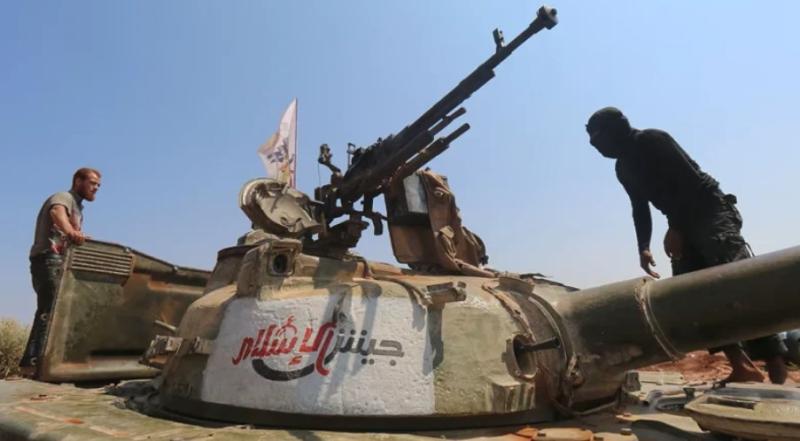
Debates over transitional justice in Syria do not center on a single perpetrator. Multiple actors have been implicated in violations over the course of the conflict. Within that landscape, the record of Jaysh al-Islam stands out in rights reports that have documented alleged abuses including enforced disappearance, arbitrary detention, and attacks on civilians.
Jaysh al-Islam was among the most powerful armed factions to control large swaths of Eastern Ghouta for years, before relocating to northern Syria following a settlement agreement and the killing of its leader, Zahran Alloush.
The Douma Four
One of the most prominent cases tied to areas under the group’s control is the December 2013 abduction of lawyer and human rights activist Razan Zaitouneh, her husband Wael Hamada, activist Samira al-Khalil, and activist Nazem Hammadi in Douma.
Although the faction denied responsibility, its effective security control over the area at the time has made the case emblematic of impunity in opposition-held territories. The fate of the four remains unknown, leaving the case among the most urgent unresolved files of enforced disappearance for any future transitional justice process.
Radio Rozana has produced several investigations and reports tracing those responsible for the crime, identifying specific individuals allegedly involved.
Human Shields
In 2015, widely circulated videos showed detainees held in metal cages placed in exposed areas of Eastern Ghouta. The practice was attributed at the time to Jaysh al-Islam, which said it aimed to deter government airstrikes.
If proven in court, such acts could amount to war crimes under international humanitarian law. The use of civilians or prisoners to shield military targets constitutes a grave violation of the laws of armed conflict.
The fate of several individuals seen in those videos also remains unknown, underscoring that the legal classification of crimes does not change based on the perpetrator.
Arbitrary Detention and Torture
Human rights organizations reported that, during the group’s control of Eastern Ghouta, it operated detention centers, most notably the facility known as “al-Tawba Prison,” where civilians, activists and dissenters were held without due process. Testimonies described torture and ill-treatment.
Such violations strike at the core of human dignity and leave long-term scars on victims and society alike. Without acknowledgment and reparations, any transitional justice framework would remain incomplete.
Attacks on Civilians
Jaysh al-Islam acknowledged firing shells and Katyusha rockets at the capital, Damascus, on multiple occasions—attacks that resulted in civilian casualties. The group framed the strikes as retaliation for government bombardment of Eastern Ghouta, with Alloush at one point declaring Damascus a “military operations zone.”
Repression of Civil Society
The Syrian Network for Human Rights documented attacks in 2017 on the office of the Violations Documentation Center in Douma, attributed to individuals linked to the faction. The incidents reportedly involved vandalism, assault and theft, alongside the closure of several other civil society organizations in the city.
This pattern suggests that some armed groups sought not only to confront military adversaries but also to dominate civic space, complicating efforts to build democratic local institutions during the conflict.
International Documentation
The Syrian Center for Media and Freedom of Expression has said it submitted 225 files of evidence—including documents, witness testimonies, videos, photographs and internal information—to the U.N.’s International, Impartial and Independent Mechanism (IIIM).
According to the center, the material implicates the group and 147 of its leaders in alleged war crimes and crimes against humanity committed between mid-2012 and April 2018. The documented allegations include targeting civilian gatherings, enforced disappearance, abduction, arbitrary detention, torture, extrajudicial killing, complicity in besieging civilians, the use of human shields, monopolizing food supplies and recruiting children.
Unauthorized Weapons
In 2020, the group acknowledged referring a field commander to its military judiciary after he used “unauthorized weapons” during clashes on the Sheikh Maqsoud front in Aleppo. The move followed reports by Kurdish media alleging the use of toxic substances in shelling the neighborhood, with cases of suffocation reported at a local clinic.
In 2025, a criminal court in Paris sentenced former Jaysh al-Islam spokesman Majdi Nema to 10 years in prison for complicity in war crimes in Syria. The case highlights the role of universal jurisdiction in pursuing accountability when domestic avenues are unavailable.
The Broader Question of Justice
The record of Jaysh al-Islam—like that of other actors implicated in abuses in Syria—underscores a central reality: the country’s future cannot be built on denial, selective justice or collective amnesia. Accountability must extend to all those involved in torture, enforced disappearance, unlawful killing, arbitrary detention and the use of civilians as instruments of war.
Transitional justice is not retribution. It is a framework aimed at establishing the truth, holding perpetrators accountable, providing redress to victims, reforming institutions that enabled abuses, and ensuring non-recurrence.
In Syria, these goals cannot be achieved if violations are attributed to only one side. A victim remains a victim, regardless of whether the perpetrator belongs to the state, opposition factions, or any other armed group.