


Reports | 28 04 2026
 Habib Shhada
The Syrian Trade Establishment is moving to modernize its structure and visual identity, amid reports of negotiations with companies from three countries to select an international partner to manage 500 branches across Syria’s provinces.
The network’s activities cover food products, clothing, household goods and electrical appliances.
In early April, the Syrian Trade Establishment revealed a plan to lease more than 500 outlets out of its total 1,280 branches nationwide, as part of what it described as a “reform vision to compensate for losses and invest assets.”
Amer Qassoum, director of the Syrian Trade Establishment, said in a press statement that the establishment — which resumed operations after a period of closure following the fall of the former regime — is seeking immediate financial returns while working to unify the visual identity of its remaining outlets.
He described the leasing of outlets as a “corrective measure to address high indebtedness,” which he said has reached 50 billion Syrian pounds. The current restructuring plan, he added, aims to focus on viable investment opportunities and address financial deficits.
This report by Rozana examines the real feasibility of restructuring the Syrian Trade Establishment, its impact on Syrian citizens, its ability to create job opportunities for young people, and its broader effect on the national economy — questioning whether it will support or weaken it through imports and unfair competition with local industry.
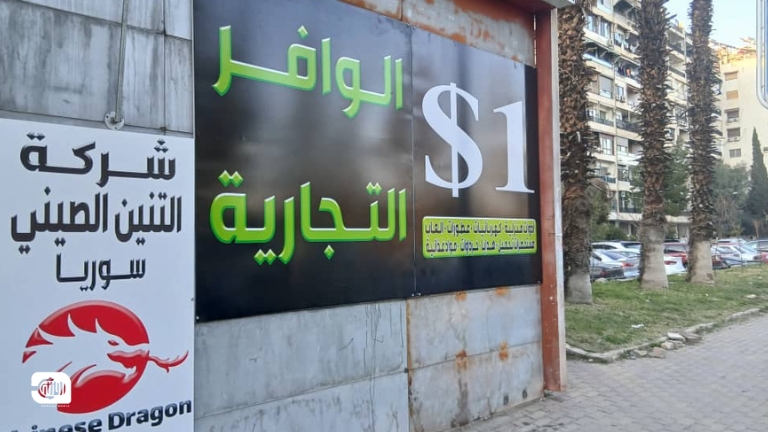
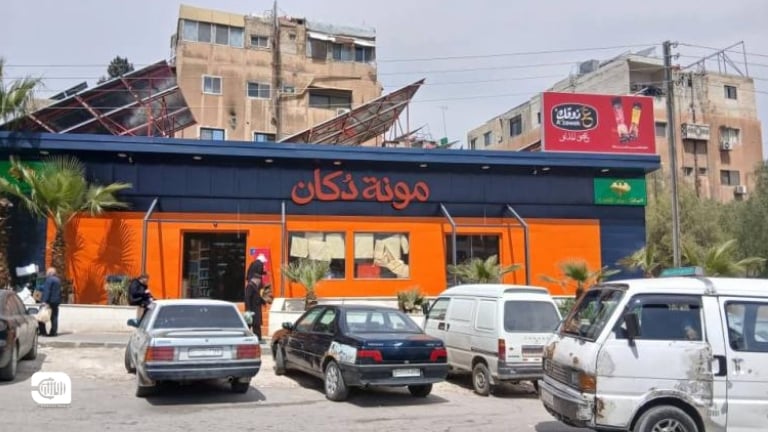
A Syrian Trade Establishment outlet in Damascus’ Mezzeh district displaying signage belonging to a private company — Rozana
Not a “Positive” Intervention
Ghanem Mohammad, a private-sector employee in Damascus, expressed concerns to Rozana about the privatization of Syrian Trade Establishment outlets. Mohammad, who earns a salary of 3 million Syrian pounds, said leasing these outlets would undermine their role in regulating prices and providing goods suited to limited incomes.
“The objective will shift toward profit at the expense of the poor,” he said.
He added that he still relies on these outlets due to their prices, which are often lower than or comparable to those in the open market.
Qassem Abu Dast, a professor of international economic relations at Damascus University, said the plan aims to rehabilitate outlets and improve service quality, but warned of the “dominance of the commercial aspect,” which could make these outlets accessible only to higher-income groups while marginalizing poorer segments.
“What is happening is a redefinition of the establishment’s role, prioritizing profit over its social function,” he told Rozana. “This comes amid a debt crisis and longstanding administrative and financial imbalances.”
A key question, he added, concerns the future of the establishment’s strategic role. Its shift toward profitability could threaten its original function as a guardian of food reserves — a role that ensures market stability and gives the state the ability to protect consumers when necessary.
Meanwhile, Maher al-Hassan, deputy minister of economy for domestic trade, said in an interview on the Syrian Al-Ikhbariya channel that the Syrian Trade Establishment would continue to provide food baskets, including vegetables, fruits and meat, “at affordable prices.”
According to Rozana’s field observations, some outlets have already begun to change. Storefronts in parts of Damascus show new signage indicating private-sector investment. In the Mezzeh district, two outlets display the names “Mouneh Dukkan” and “Al-Wafer Trading,” though no further details are available about these entities or whether they are private companies investing in the establishment’s branches.
Layoffs Concerns
While Mohammad fears that access to subsidized goods will diminish, Alaa, a former employee, doubts the plan will generate jobs. Alaa worked for six years at a Mezzeh branch in Damascus before losing his position in 2025 as part of workforce reductions targeting what authorities described as “surplus labor” during the tenure of the transitional government led by Mohammad al-Bashir, which followed the fall of the former regime.
“I spent years arranging goods on the shelves,” he said. “But after the fall of the former regime, I was dismissed.”
Alaa believes new investors will prioritize financial returns over job creation.
The Syrian Trade Establishment employs around 4,500 workers, operates 1,280 outlets and more than 150 warehouses. Qassoum said the establishment aims to establish a network of 440 outlets under a unified identity and sales system to improve access to competitively priced goods while maintaining the ability to intervene in the market when needed.
According to Qassoum, the targeted outlets have been divided into two categories, with financial and technical conditions set for investors, including preparation and operation under contracts of up to 10 years, subject to review and evaluation.
Abu Dast warned that a profit-driven approach could lead to layoffs of existing staff under the pretext of surplus labor or inefficiency, especially if restructuring or privatization fails to create alternative employment opportunities.
Unfair Competition Risks
On the other hand, economists warn of potential negative consequences for domestic production.
Abu Dast pointed to the risk of creating a dominant market player by granting control of 500 outlets to a single entity, whether domestic or foreign — a move that could undermine fair competition in the local market.
He also warned that granting customs exemptions on imported goods to the investing company would create unjustified advantages over domestic products, weakening their competitiveness.
As a result, the Syrian Trade Establishment faces a complex transition toward a profit-oriented model — a step aimed at improving efficiency but one that carries risks to the state’s service role.
Economists, including Abu Dast, argue that the success of this transformation depends on a clear legal and regulatory framework that ensures a balance between profitability and social responsibility.