


Reports | 9 03 2026
 rozana
Syria’s transitional phase has created a legislative vacuum that has allowed broad interpretations—and at times exploitation—of concepts such as “personal freedoms” and “public morality.” The detention of individuals accused of openly breaking the fast during Ramadan has emerged as a clear example of this dilemma, raising questions about the boundaries between social norms, religious sensitivities, and the rule of law.
Syria is currently experiencing a legislative vacuum during its transitional phase, a situation that has contributed to competing interpretations—and at times the instrumentalization—of concepts such as “personal freedoms” and “public morality.”
The detention of individuals accused of publicly breaking the Ramadan fast has become one manifestation of this issue. Arrests and brief detentions have been carried out on the basis of social customs that lack a clear legal or legislative framework, revealing how “public morality” can be invoked as a pretext to restrict individual freedoms in the absence of a strong rule of law.
These infringements on public freedoms come amid the growing influence of a hardline religious current that reflects the Salafi-jihadist background of Hayat Tahrir al-Sham, which has come to govern Syria during the transitional period. This trend was highlighted in a report by the organization Syrians for Truth and Justice titled “Transformations of the Religious Sphere in Syria After the Fall of the Regime: A Reading of Exclusion, Radicalization, and Pressures,” published in July 2025.
No Law Criminalizing Breaking the Fast
Although Syrian law does not explicitly criminalize publicly breaking the fast during Ramadan, this has not prevented detentions. Among the reported cases were the arrest of a female employee in the city of Salamiyah in the Hama countryside and the detention of a journalist in Aleppo—incidents that sparked widespread debate on social media about the limits of public morality.
These interventions in private life reflect a form of government enforcement of social and moral norms, particularly after the fall of the former Syrian regime in late 2024 and the assumption of power by Hayat Tahrir al-Sham. This occurs despite the absence of any explicit provision in the Syrian Penal Code punishing those who break the fast during Ramadan.
Last year, Syria’s Ministry of Endowments issued a circular to public and private institutions calling for respect for the sanctity of Ramadan and prohibiting the public breaking of the fast during the month, warning that violators could face penalties under Article 462 of the Syrian Penal Code.
Article 462 stipulates:
“Anyone who, by any of the means specified in Article 208, insults religious rituals that are publicly practiced or incites contempt for such rituals shall be punished by imprisonment for a period ranging from two months to two years.”
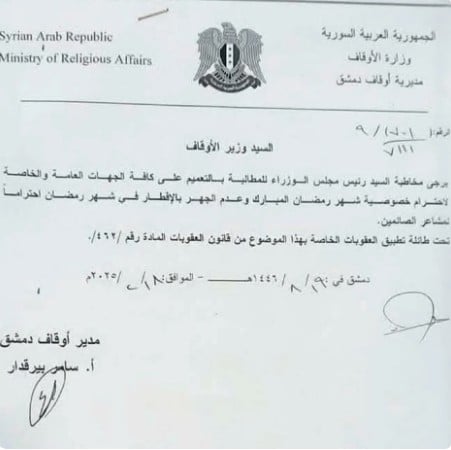
Syrian government circular on public fasting during Ramadan – Source: Internet
What Happened?
In Salamiyah, in the Hama countryside, a female employee at the Salamiyah courthouse was detained for several hours before being released on charges of “publicly breaking the fast.” The detention was carried out based on a decision issued by the public prosecutor in Hama after she was reportedly seen chewing gum in front of visitors inside the courthouse.
Judicial authorities said the act constituted “publicly breaking the fast during Ramadan,” describing it as “uncivil behavior in front of visitors and contrary to public morality,” according to statements attributed to Judge Radwan al-Hammoud, head of the public prosecution in Salamiyah, cited by the local outlet Salamiyah Newspaper on its Facebook page.
The Syrian Penal Code does not provide a precise legal definition of the concepts of “insult” or “contempt” with regard to religious rituals. As a result, legal scholars have attempted to interpret these terms. Most agree that they essentially refer to acts of insult—meaning that any statement or action that demeans religious rituals practiced in public may be considered an offense or an act of contempt.
The law does not limit punishment to direct insults. It also criminalizes incitement to contempt for religious rituals—that is, calling for or encouraging their denigration. Any act that involves inciting others to insult publicly practiced religious rituals may therefore constitute a punishable offense. In this regard, the legal text does not distinguish between religions and applies to all faiths.
For such an offense to be established, the act must be carried out publicly. Article 208 of the Penal Code defines what constitutes publicity, including acts or gestures occurring in public places or locations open to the public or visible to others, as well as speech or shouting that can be heard by others either directly or through technological means.
Publicity can also be established through writings, drawings, photographs, films, or symbols displayed in public places or sold or distributed to one or more individuals.
Accordingly, the presence of both an element of insult and an element of publicity forms the legal basis for the crime of insulting religious rituals under the Syrian Penal Code.
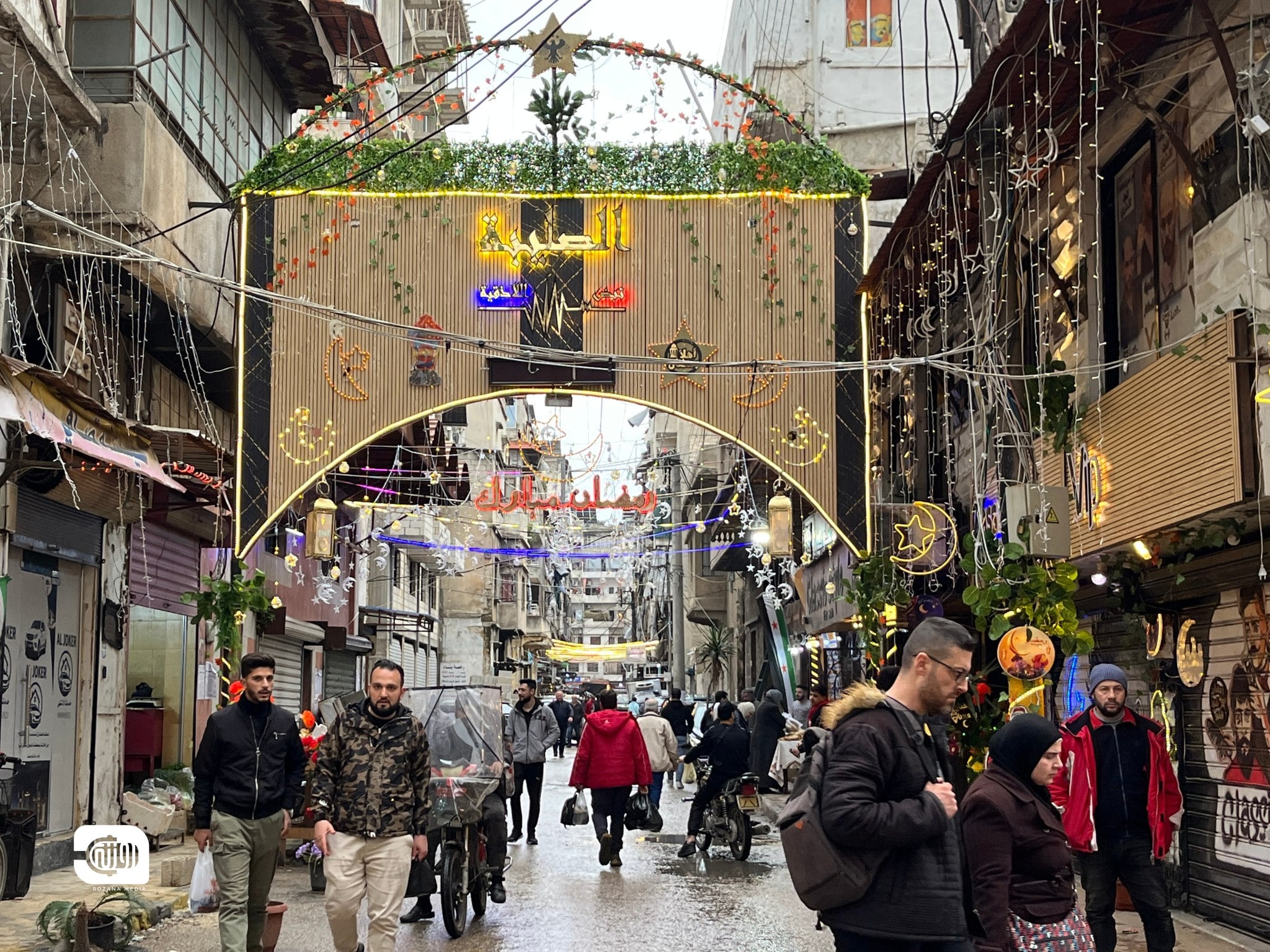
Ramadan markets in Syria – Rozana
Smoking Prohibited
In Aleppo, journalist Wissam Mohammad was also detained on the pretext of breaking the fast and says he was treated “poorly.” According to his account, a checkpoint noticed he was holding a cigarette during the daytime, which led to his detention and being called a “disbeliever.”
Meanwhile, in the Damascus countryside, the public prosecution issued a circular prohibiting the public breaking of the fast inside the courthouse during Ramadan and warning of penalties for violators, according to the website Syria TV.
“Please refrain from smoking and publicly breaking the fast out of respect for the feelings of those who are fasting. In the event of a violation, a report will be filed, the offender will be detained, and a public lawsuit will be initiated pursuant to Article 517 in conjunction with Paragraph 1 of Article 208 of the Penal Code, on charges of offending public morality.”
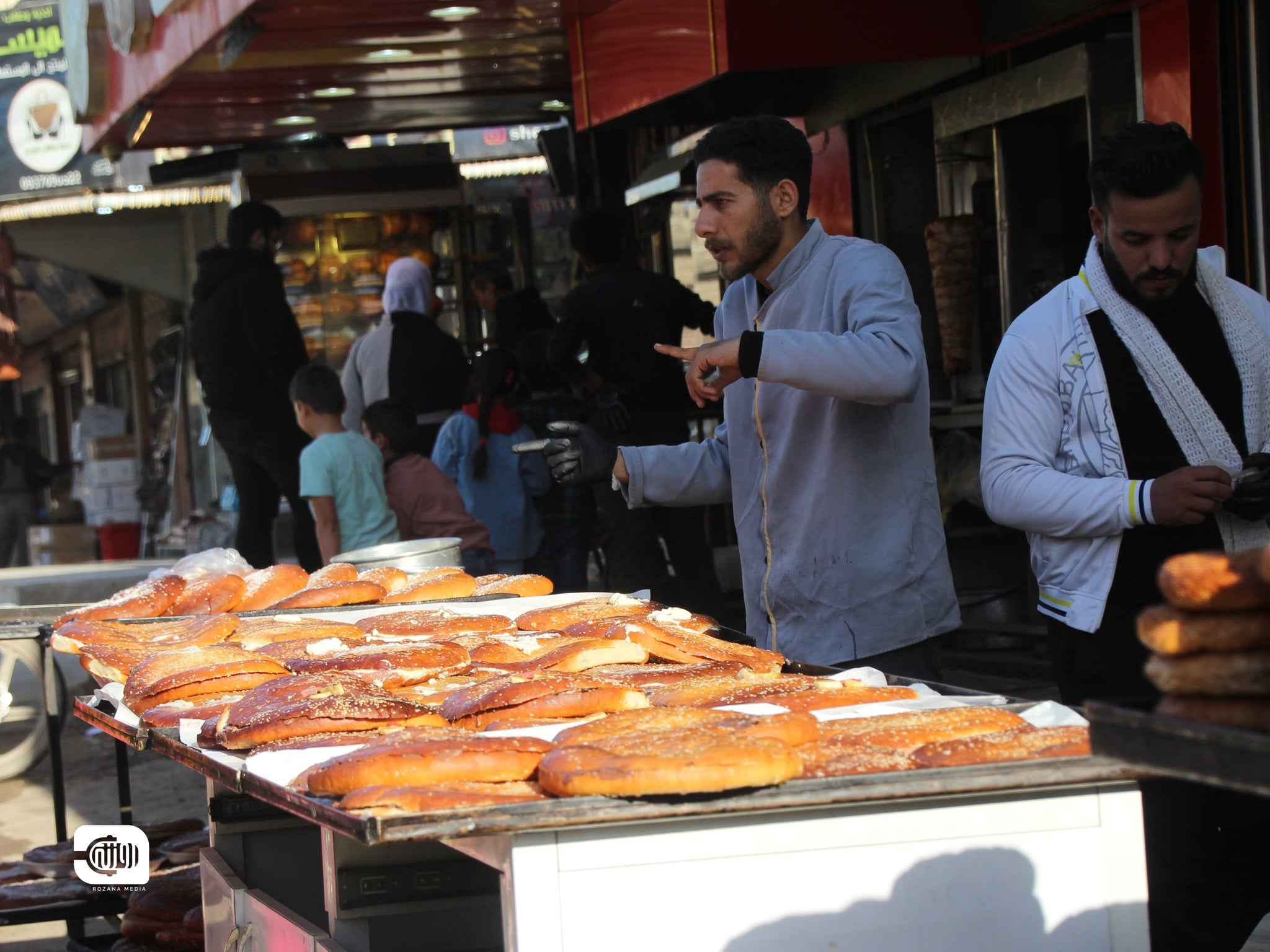
Ramadan markets in Syria – Rozana
No Punishment Without Legal Text
Syrian lawyer Tahseen Hassan stresses that the Syrian Penal Code does not explicitly stipulate a penalty for publicly breaking the fast during Ramadan.
Speaking to Rozana, Hassan said that the penalty stems instead from an old precedent established by the Court of Cassation, which classified publicly breaking the fast during Ramadan under the category of “violating public morality.”
He explained that Article 208 of the Penal Code does not contain a specific penalty for those who publicly break the fast during Ramadan. Rather, interpretations of the article are being used to apply old judicial precedents that are not legally binding but have effectively become a tool for restricting public freedoms.
Hassan added that the concepts of “public morality” and “public decency” in the Syrian Penal Code refer specifically to acts considered offensive to modesty in public spaces. The law does not include any provision criminalizing breaking the fast during Ramadan or defining it as an act contrary to public morality.
According to Hassan, judicial authorities are effectively expanding the concept to include adherence to religious rituals.
This interpretation appears to have been applied by the head of the Salamiyah public prosecution, who said the employee’s detention was based on Article 517 of the Syrian Penal Code, issued under Legislative Decree No. 148 of 1949. The article stipulates penalties for violating public morality, including publicly breaking the fast during Ramadan, with imprisonment ranging from three months to two years.
Hassan argued that such measures also contradict the temporary constitutional declaration, which explicitly guarantees the protection of personal freedoms.
He stressed a fundamental legal principle: “There is no crime and no punishment without a legal text.”
Uneven Enforcement
In contrast, the situation appears different in cities such as the capital, Damascus. Observations by Rozana indicate that restaurants and cafés operate during daytime hours in Ramadan without restrictions. In streets and public parks, people can also be seen eating, drinking, and smoking without interference.
The controversy surrounding the detention of individuals for publicly breaking the fast—whether based on legal provisions or not—reflects a broader struggle between interpretations of freedom and public morality by today’s judicial authorities, and modern human rights principles that guarantee freedom of belief and other civil liberties.