


Reports | 6 12 2025
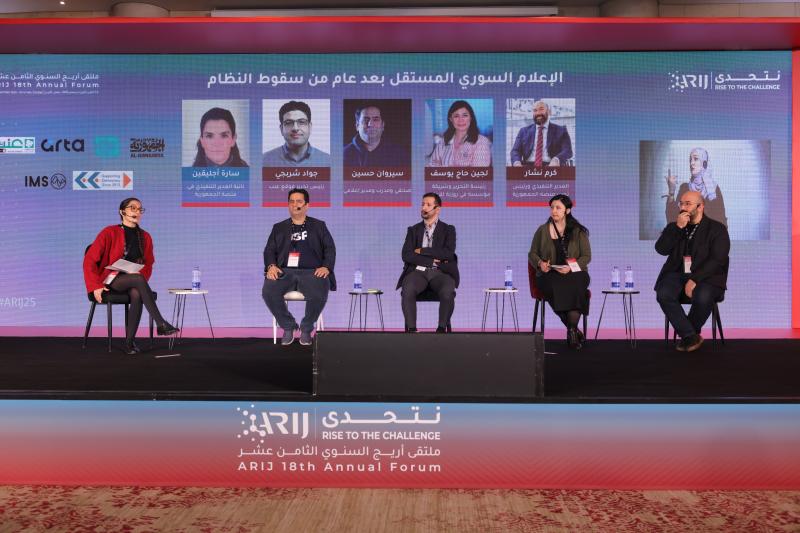
A panel titled “Independent Syrian Media One Year After the Fall of the Regime” examined the challenges facing Syria’s media landscape, including fragmentation, the existence of multiple competing authorities, the persistence of regulatory and censorship structures, and the spread of disinformation. These challenges have been further exacerbated by declining international support and the erosion of public trust in the media.
The panel was held in parallel with the launch of the Syrian Independent Media Union, in partnership with Al-Jumhuriya, ARTA, Enab Baladi, Radio Rozana, the European Endowment for Democracy (EED), and the International Media Support (IMS).
The discussion brought together Karam Nashar, Executive Director and Editor-in-Chief of Al-Jumhuriya; Loujein Haj Youssef, Editor-in-Chief and Co-Founder of Radio Rozana; Sirwan Hussein, journalist, media trainer, and media manager; and Ammar Ziada, Managing Editor of Enab Baladi. The session was moderated by Sarah Ajleqin, Deputy Executive Director of Al-Jumhuriya.
Karam Nashar highlighted the profound impact of current political realities on Syrian society, noting that while public discourse is now more directly addressed to society, trust in authority has significantly declined. “Many people I speak to say that society today is less trusting and less receptive to those in power,” he said.
For her part, Loujein Haj Youssef stressed that independent Syrian media has been a key partner in driving change, describing it as “the last line of defence for truth.” She emphasized that maintaining media independence is essential to holding authorities accountable, rebuilding public trust, and safeguarding the right to access accurate information during a highly fragile transitional phase.
Sirwan Hussein argued that any discussion about a state based on law, justice, and citizenship is inseparable from the existence of independent media. “There can be no state of institutions without independent media that monitors authorities and exposes violations,” he said, adding that independent media remains the only real guarantee for building a state governed by the rule of law.
Ammar Ziada spoke about the noticeable shift in public engagement following the collapse of the former regime’s authority. He described a sudden openness, with audiences rapidly interacting with media outlets and social media platforms alike. “People finally felt able to speak, express themselves, and release what had long been suppressed under years of repression and silence,” he said.
Ziada’s remarks echoed Haj Youssef’s observations, as she noted that this new openness places greater responsibility on independent media—not only to amplify people’s voices, but also to protect them from disinformation, organize public debate, and defend truth in a deeply fragile context.
The panel was held on 5 December as part of ARIJ 18, marking a key moment alongside the official launch of the Syrian Independent Media Union, aimed at strengthening cooperation among independent Syrian media outlets and reinforcing the role of free and independent journalism during Syria’s transitional period.