


Reports | 15 12 2025
 loujein haj youssef
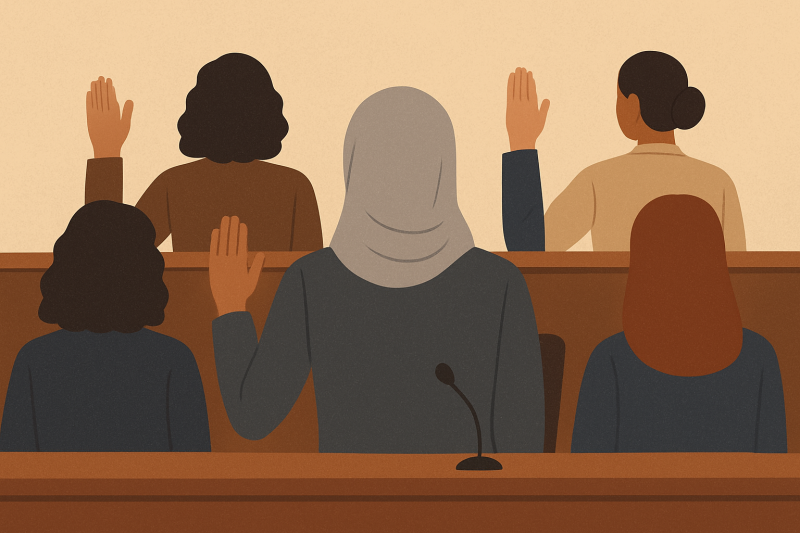
The preliminary results of Syria’s People’s Assembly elections, held on Oct. 5, delivered a stark and troubling message: only six women won seats out of 119 a mere 5.04 percent.
In response, President Ahmad al-Sharaa attempted humor. “I’m afraid they’ll call me a feminist,” he said. To some, the remark may have sounded casual or even witty. In reality, it revealed something far more serious: a deep misunderstanding of gender justice — and an effort to use sarcasm as a shield in front of a patriarchal society that did not vote for women, but applauded the joke instead.
The real question is not whether Syria needs “more women” for the sake of appearances. It is whether Syria can claim any democratic legitimacy while systematically excluding half of its population from legislative power.
?Why quotas exist? and why Syria needs one
Women’s quotas were never meant to be gifts, favors, or decorative democratic gestures. They exist because political “neutrality” has never been neutral.
For decades, Syrians were told that politics was open to everyone. In theory, the door was open. In practice, the path to it was blocked by structural barriers that applied almost exclusively to women: political financing networks dominated by men, party hierarchies built without women in mind, social expectations that confined women to caregiving roles, entrenched stereotypes, and pervasive political violence.
Waiting for “natural change” in such a system does not produce equality — it reproduces exclusion. That is why quotas emerged globally as a corrective mechanism: a temporary intervention designed to rebalance a historically distorted playing field. Not to privilege women, but to give democracy a fair starting point.
When structural barriers disappear and women’s political participation becomes normal rather than exceptional, quotas become unnecessary. Corrective tools exist only as long as the imbalance persists.
“Competence, not gender” is not a neutral argument
Every time women’s representation is discussed, the same refrain resurfaces: “What matters is competence, not gender.”
It sounds reasonable — until one considers how politics actually works. Politics is not a neutral equation; it is shaped by lived experience. Excluding women from parliament does not simply remove half the population from decision-making. It removes half of human experience from the table where laws are written.
Women’s presence in parliament is not symbolic. It directly improves the quality of legislation. When women enter legislative spaces, they bring perspectives shaped by navigating work and care, exposure to discrimination, experiences of motherhood, negotiation of social constraints, and vulnerability to gender-based violence.
These are not “women’s issues.” They are societal realities.
Research consistently shows that women legislators prioritize education, health care, child welfare, social protection, and domestic violence prevention all foundational pillars of state stability and social cohesion.
A parliament debating parental leave laws is better equipped when some of its members have experienced pregnancy, childbirth, and caregiving firsthand — rather than learning about them abstractly. Laws grounded in lived reality are more precise, more humane, and more effective.
More women, better governance
The argument for women’s representation is not moralistic. Women are not inherently more virtuous, nor are men inherently corrupt.
Yet evidence from the World Bank and the United Nations Development Programme shows that parliaments with higher female representation tend to produce more inclusive legislation, operate more collaboratively, and exhibit lower levels of corruption and higher transparency.
This is not accidental. Women who overcome systemic barriers to reach power often arrive with exceptional resilience and competence. Traditional corruption networks — historically male-dominated — are less accessible to them. And women in leadership positions are often under greater scrutiny, pushing them to perform with heightened accountability.
In short, women’s political inclusion strengthens institutions.
Representation shapes ambition
Political representation does more than change laws. It reshapes imagination.
When girls grow up seeing only men in parliament, ministries, and leadership positions, they internalize an unspoken message: politics is not for them. Sociologists call this the “glass ceiling” — invisible, but decisive.
Seeing women in legislative authority changes that equation. A girl who sees a woman speaking in parliament sees a future possibility for herself. Representation does not merely reflect society; it expands the horizon of what society believes is possible.
This is where quotas move beyond numbers and become tools for national transformation.
Syria’s commitments and its failure
Syria is not exempt from international standards. It has committed to the Convention on the Elimination of All Forms of Discrimination Against Women (CEDAW), the Beijing Platform for Action — which recommends at least 30 percent female representation — and the U.N. Sustainable Development Goals, which treat women’s participation in decision-making as a core indicator of progress.
Even Syria’s transitional government previously pledged a minimum of 20 percent women in parliament. Today’s 5.04 percent is not merely a statistical shortfall. It is a political, ethical, and international failure.
President al-Sharaa attributed the results to a patriarchal society that did not vote for women. But the more important question is not whether society is patriarchal. It is whether the state is willing to challenge that reality — or simply accommodate it
A choice with historical consequences
Mr. President, when you said you feared being labeled a feminist, you acknowledged a cultural truth. But that truth is precisely what leadership exists to change, not to echo.
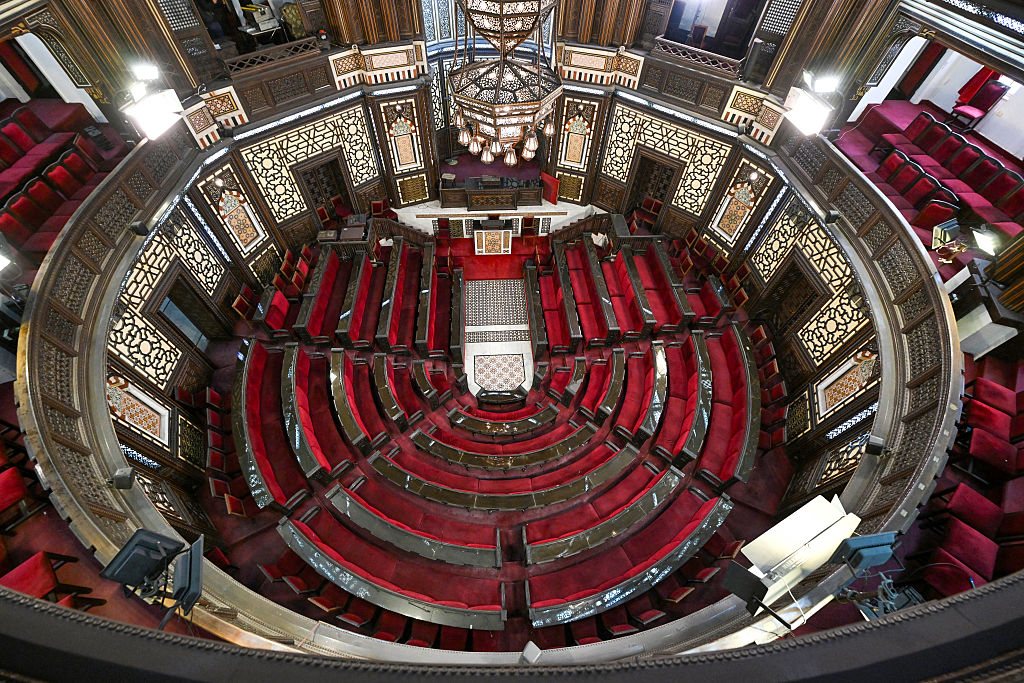
You now face a historic choice: build a Syria that invests in the potential of all its citizens — or recreate the failures of the past by sidelining women and wondering why development stalls, corruption persists, and parliament feels detached from everyday life.
To political parties: How many women did you nominate? Where did you place them on electoral lists? Were they in winning positions — or relegated to the bottom as electoral decoration?
And to Syrian women watching these results with disappointment: this is not your failure. It is the failure of a system that continues to deny you fair access — and then blames you for the outcome.
Quotas are not a magic solution. But they are a necessary beginning. They are not a source of embarrassment, but a constitutional, international, and ethical commitment to ensure that parliament reflects the society it claims to represent.
The question is not whether supporting quotas makes one a feminist.
The real question is: What kind of Syria do we want? History is watching.